

By celestine Okafor (Editor-in-chief)
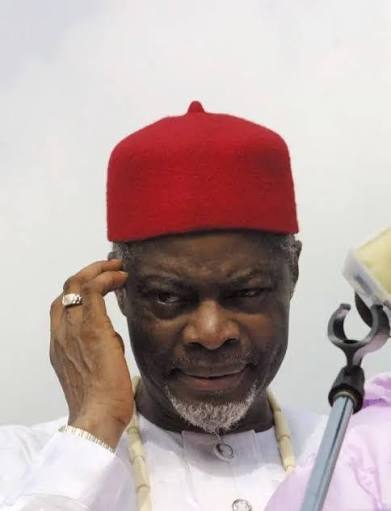
As Nigeria prepares for another consequential general election in 2027, the country’s political landscape will once again be dominated by familiar themes—power, regional interests, party alliances, leadership, national unity and the search for a more responsive democratic order. Yet, beneath the noise of contemporary politics lies a question of historical memory: what would Nigeria’s political conversation look like if Dr. Chuba Wilberforce Okadigbo, Nigeria's former Senate President, were still alive and active in the 2027 contest?
It is a question worth asking, not because the late politician should be projected into a political choice that belongs to today’s electorate, but because his career represents an era when Nigerian politics was populated by politicians whose backgrounds combined academic scholarship, political activism, legislative experience and a pronounced appetite for intellectual argument.
Okadigbo died on September 25, 2003, aged 61, only months after serving as the running mate to former President, Muhammadu Buhari in the 2003 presidential election. His death, after a police teargas was sprayed on him and Buhari during a political rally in Kano, came at a moment when Nigeria’s Fourth Republic was still finding its political identity.
Twenty-three years later, the country is preparing for the 2027 elections. The Independent National Electoral Commission (INEC) has scheduled the presidential and National Assembly elections for January 16, 2027, while the governorship and State Houses of Assembly elections are scheduled for February 6, 2027.
The political Nigeria of 2027, however, is vastly different from the Nigeria Okadigbo knew. Chuba, a politician who was also an intellectual, was not an ordinary political actor. His biography combined scholarship and politics in a manner that has become increasingly uncommon in Nigeria's political arena. Born on December 17, 1941, Senator Chuba Okadigbo obtained advanced degrees in philosophy and political science and taught in American universities before returning to Nigeria. He subsequently lectured at the University of Nigeria, Nsukka, served as political adviser to firmer President Shehu Shagari and became involved in national party politics.
His political career subsequently took him into the Senate in 1992 and 1999. He became Senate President on June 2000 after the removal of Senator Evans Enwerem, although his tenure lasted only a few months before he was himself removed from office.
Whatever controversies surrounded his political career, Okadigbo left behind the image of a politician who enjoyed political combat and intellectual engagement. He was capable of turning parliamentary and political disagreements into broader arguments about Nigeria's political direction.
That quality would have made his presence in the 2027 political environment particularly intriguing.
FROM 2003 TO 2027
Okadigbo's final major national electoral assignment was the 2003 presidential election, when he was Buhari's running mate on the platform of the defunct All Nigeria Peoples Party (ANPP). The ticket ultimately lost to the incumbent Olusegun Obasanjo-Atiku Abubakar ticket. But history sometimes acquires a different meaning with time.
The Buhari-Okadigbo ticket was one of the early attempts by the opposition to construct a national presidential coalition around a candidate from the North and a prominent politician from the Southeast. Okadigbo's selection therefore carried both political and symbolic significance. He was the Senator who represented Anambra North, a parliamentary seat his beloved wife, Senator Margery Okadigbo, popularly known as 'Odibeze' also occupied between 2011 and 2015.
Chuba Okadigbo died before he could see how Nigerian opposition politics would subsequently evolve. He would not witness the emergence of new political coalitions, the transformation of the ANPP and other opposition forces, the birth of the All Progressives Congress (APC), or Buhari's eventual election as president in 2015 and in 2019, nor would he see the political developments that have brought Nigeria to the threshold of the 2027 elections.
WHAT IS MISSING POLITICALLY WITHOUT CHUBA?
To imagine the 2027 elections without Okadigbo is to imagine Nigerian politics without one of its more distinctive political voices. He would have been 85 years in December 2027. Age alone would not necessarily have removed him from public life. Nigeria has repeatedly demonstrated that political longevity can extend far beyond conventional retirement ages. Whether he would have remained an active politician, elder statesman, political strategist, commentator or adviser is unknowable. After all, his political contemporaries and allies in the current democratic republic like Alhaji Atiku Abubakar are still contenders for elective office and political power brokers.
What can reasonably be said is that Chuba's political experience would have given him a historical perspective spanning several political eras—from the Second Republic, through military rule, the June 12 struggle for democracy and the early years of the Fourth Republic. That perspective could have added another voice to contemporary debates over federalism, restructuring, national integration, the role of political parties, legislative independence and the relationship between the different regions of the country.
THE SOUTH EAST GEO-POLITICAL ZONE AND THE NATIONAL QUESTION
Senator Chuba Okadigbo's political career also remains relevant to discussions about the Southeast's place in Nigeria's national politics. The great 'Oyi of Oyi' and the 'Ikenga Igwuedo' represented Anambra North District in the Senate and occupied one of the country's most powerful legislative offices.
His political journey illustrated both the possibilities and difficulties confronting politicians from the Southeast who sought influence beyond regional politics. In 2003, his political partnership with former President Buhari was also an attempt to construct a presidential ticket that crossed Nigeria's major regional fault lines.
THE NATION
In today's Nigeria, where questions of regional inclusion and national power-sharing continue to feature prominently in political discourse, Chuba Okadigbo's career provides historical material for examining how such alliances have been constructed and the challenges they have encountered.
Perhaps the greatest absence in 2027 is not simply the man but the political culture he represented. Okadigbo belonged to a generation in which political figures often presented themselves as thinkers as well as politicians. His published works included Logic for Black Undergraduates, Consciencism in African Political Thought and Power and Leadership in Nigeria.
Modern Nigerian politics, by contrast, is increasingly shaped by social media, instant political messaging, personality-driven campaigns and highly sophisticated electoral communication. A politician of Okadigbo's intellectual temperament operating in today's digital environment would probably have encountered a completely different political battlefield—one in which speeches are reduced to viral clips, political arguments are fought simultaneously on television and social media, and public perception can change rapidly. Yet his ability to combine political rhetoric with academic argument might also have made him a formidable participant in such an environment. That, however, remains a historical hypothesy rather than something that can be established.
2027 AND THE QUESTION OF POLITICAL LEGACY
The approaching election provides an opportunity to look beyond individual candidates and parties and ask what Nigerian politics has learned from its past. The Independent National Electoral Commission (INEC), has, itself, stressed that the success of the 2027 elections is a collective responsibility involving political parties, candidates, security agencies, the media, civil society and the citizens. That observation is particularly relevant when viewed through Okadigbo's political history.
He lived through periods when Nigeria's democratic institutions were fragile. He participated in party politics, legislative politics and opposition politics. He witnessed military intervention in politics and later participated in the return to constitutional government.
Okadigbo's generation therefore understood, in a very direct way, that democratic institutions cannot be taken for granted.The 2027 election will test a different generation.
The most important question surrounding Chuba Okadigbo's absence in 2027 politics is therefore not whether he would have supported one candidate or another. There is no reliable way to answer that question.
The more useful question is what lessons his political life leaves for those who will contest and vote in 2027. His career demonstrates the importance of political education, legislative experience, ideological argument, party organisation and national coalition-building. It also illustrates the uncertainties and reversals that frequently accompany Nigerian politics.
Okadigbo rose to the presidency of the Senate and later became a presidential running mate. His career was marked by considerable achievement but also controversy and political setbacks. His story is therefore neither a simple tale of triumph nor one of failure. It is a story of participation. And that may be the most appropriate way to remember him as Nigeria approaches another election.
A SEAT AT THE TABLE THAT HISTORY HAS LEFT EMPTY
When Nigerians vote in 2027, Chuba Okadigbo will not be on the ballot. He will not address campaign rallies, negotiate party alliances, appear on television debates or speak from the floor of the Senate. But his political generation will remain part of the country's historical conversation. Every election is partly a contest over the future and partly a referendum on the lessons of the past. The absence of Okadigbo in 2027 therefore offers Nigeria an opportunity to remember a politician who straddled academia and politics, opposition and government, the legislature and presidential politics.
The Nigeria of 2027 will have its own political actors and its own challenges. They will write their own chapter. But somewhere in the pages of Nigeria's political history stands Chuba Okadigbo—a former Senate President, scholar, political strategist and presidential running mate whose voice fell silent in 2003, long before the country arrived at the political crossroads of 2027. Nigeria will go to the polls without Chuba Okadigbo. But the political questions that occupied his generation—leadership, representation, national unity, institutional integrity and the meaning of democracy—will still be waiting for answers. NNL.