


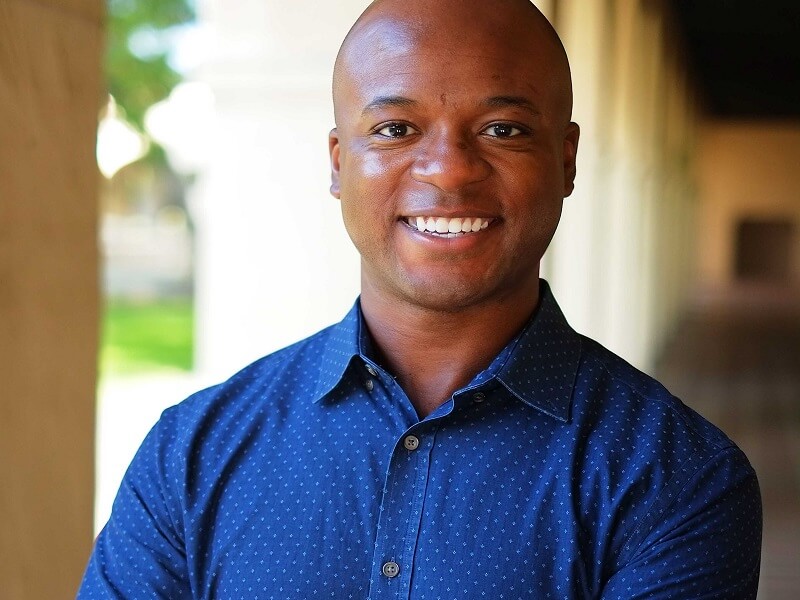

By Ikemsinachi Bobo Okafor
President of the United States of America, Joe Biden, has announced the appointment of 41-year old Prof John Oluseun Dabiri, a Nigerian-American aeronautical engineer, as a member of the US president’s council of advisors on science and technology.
A White House press statement in Washington DC, US administrative capital on Wednesday announced Dabiri's appointment.
The young Nigerian-born biophysicist is presently a professor of aeronautics and mechanical engineering at the California Institute of Technology (Caltech). He was born to Nigerian immigrant parents who are American immigrants, in 1980.
Professor John Dabiri is an engineer who designs next-generation wind turbines with the potential to reduce cost, size, and environmental impacts while maximizing the amount of electricity generated.
The White statement said discoveries on the ideal placement of wind turbines were shaped by Prof John Dabiri's "cross-disciplinary research into how jellyfish and schools of fish move throughout the ocean efficiently,” it reads.
He has also been awarded “the MacArthur “Genius” Fellowship, the Presidential Early Career Award for Scientists and Engineers, and the Alan T. Waterman Award from the National Science Foundation”.
Dabiri was appointed alongside 29 other persons, and the council is expected to provide recommendations on policies to encourage innovations in science and technology in the US.
“Today, President Biden announced 30 of America’s most distinguished leaders in science and technology as members of his President’s Council of Advisors on Science and Technology (PCAST),” the statement reads.
“A direct descendant of the scientific advisory committee established by President Eisenhower in 1957 in the weeks after the launch of Sputnik, PCAST is the sole body of external advisors charged with making science, technology, and innovation policy recommendations to the President and the White House.
“Drawing from the nation’s most talented and accomplished individuals, President Biden’s PCAST includes 20 elected members of the National Academies of Sciences, Engineering and Medicine, five MacArthur “Genius” Fellows, two former Cabinet secretaries, and two Nobel laureates.
“Its members include experts in astrophysics and agriculture, biochemistry and computer engineering, ecology and entrepreneurship, immunology and nanotechnology, neuroscience and national security, social science and cybersecurity, and more.”
According to Caltech, Dabiri, who is described as the youngest member of the council, said he is honoured to have been selected, adding that he will work with other members of the council to ensure that the US benefits from the opportunities available in science and technology.
“The members of PCAST bring a diverse set of perspectives on how we can maximize the benefits of science and technology for the nation. I’m honored to have the opportunity to work with them and to be able to offer my assistance to the president,” Dabiri is quoted as saying.
“Caltech does a lot of wonderful basic science. We’ll be thinking about how we can leverage that for the American people.”
Caltech biophysicist, John Dabiri, was among the 23 recipients of the 2010 MacArthur fellowships. John Oluseun Dabiri, whose studies of schooling fish have inspired new ideas for wind farming, and whose current investigations focus on hydrodynamics behind jellyfish propulsion, heads Caltech's Biological Propulsion Laboratory.
The John D. and Catherine T. MacArthur Foundation award the $500,000, "no strings attached" grants (also known as "genius" grants) to individuals who show "exceptional creativity in their work and the prospect for still more in the future," according to the foundation's website.
Dabiri earned his bachelor's degree from Princeton University, a Master of Science in aeronautics and a PhD in bioengineering from Caltech. He joined the Caltech faculty in 2005.
Among Dabiri's distinctions are an Office of Naval Research Young Investigator Award for research in bio-inspired propulsion and a Presidential Early Career Award for Scientists and Engineers. He was also one of Popular Science magazine's "Brilliant 10" young scientists to watch in 2008.
This year's crop of fellows also includes a theater director, an anthropologist, a quantum astrophysicist, a sign-language linguist, a computer security specialist, and an installation artist. (with additional reports from TheCable). NNL.